Where to Send a Stubborn Barrel: A 2026 Field Guide to UK Piston Machining
There is a particular kind of gloom that settles over a garage when the barrel comes off and the bore looks like a ploughed field. The parts book says +0.020, the piston is a shelf-filler with a scored skirt, and the nearest engine shop is now a tyre bay with a lathe in the back. Britain still has good piston machinists, but they are not evenly spread. In 2026, the job is less about finding a unicorn and more about asking the right questions before you wrap a barrel in bubble wrap and hand it to a courier.
The map is made of clusters, not county lines
You will find the deepest pool of experience in the Midlands and the old industrial spine running up through Yorkshire and into the North East. That is no accident: plenty of small firms grew up around motorcycling, agricultural engines and general reconditioning, and some have kept the boring bars and ring-groove tooling that general garages scrapped. The South East has capable shops too, but expect higher hourly rates and longer queues because everyone within the M25 is chasing the same few people. Scotland and Wales can be trickier for one-off piston work, though there are excellent individual machinists if you are willing to post. Northern Ireland is a separate posting calculation altogether.
I am deliberately not printing a list of names I cannot stand behind from a keyboard. A useful 2026 directory is one you build by phone. Start with the vintage clubs, the trials and sprint paddocks, and the people who have actually had a barrel rebored in the last two years. Ask what the bore measured when it came back and whether the ring gaps were set by the machinist or left to the owner. That tells you more than a shiny website.
What to measure before you ask for a price
A proper piston machinist will want numbers, not adjectives. “It’s a bit scuffed” is not an enquiry. “Bore is 66.52 mm at the top, 66.49 mm at mid, 66.47 mm at the bottom, measured twice at 90 degrees, and the ring groove side clearance is 0.11 mm” is an enquiry.
Before you ring anyone, put together a small dossier:
- Bore measurements at top, middle and bottom, in two axes. A cheap telescopic gauge and micrometer is fine if you are careful; a bore gauge is better.
- Piston skirt measurement at the thrust face, plus the original bore size and any oversize stamp.
- Ring groove widths and side clearances, especially the top groove. This is where worn ring grooves hide.
- Compression height, crown thickness, gudgeon pin diameter and pin-bore condition.
- Deck height and any valve-pocket depth if the piston is not a flat-top.
- Clear, well-lit photos of the bore, the crown, the skirt, the ring grooves, the barrel flange and the spigot. Include a ruler or caliper in at least one shot.
- A note of the engine, year and state of tune. A 1950s sidevalve single and a 1960s OHV trials engine do not want the same piston clearance.
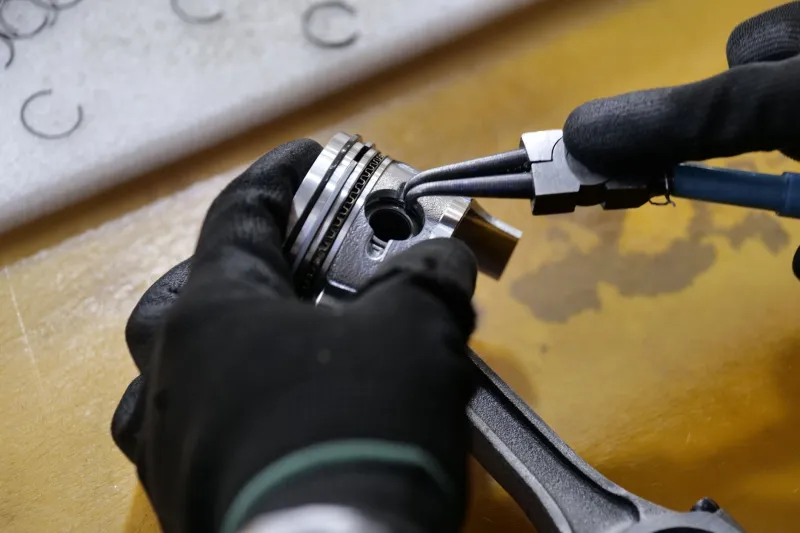
If you are asking for a one-off piston without a parts-book number, send the old piston even if it is cracked. It is a dimensional witness. A good machinist will measure it, work out what has worn or seized, and then ask about the intended use. A bad one will quote from a generic drawing and hope.
The questions that sort the trade
A general engine shop can bore a cylinder. That does not make it a vintage piston machinist. The difference shows up in the questions they ask you.
Ask whether they will bore and hone to a measured piston clearance, or just “take it out to the next size”. Ask how they set ring end gaps, and whether they expect you to file the rings yourself. Ask if they can machine a worn ring groove and fit a spacer or a new groove, and whether they have the tooling to hold the groove square. Ask what alloy they use for one-off pistons, whether they can supply rings to match, and whether they will check valve-pocket clearance against your head. Ask for the finished bore measurement in writing.
A proper piston machinist will also tell you what they do not do. They may not weld cracks. They may not touch a barrel with a badly pitted flange. They may want the piston and barrel together. They may insist on seeing the head. That is a good sign. The shop that says “bring it in, we’ll sort it” without asking about compression height is the one to thank politely and leave.
Lead times and money in 2026
Costs move about, but the shape of them is fairly consistent. A straightforward rebore and hone on a British single barrel is commonly in the £90 to £160 range, depending on the bore size, the finish required and whether the shop has to set up for a one-off. A ring-groove repair is often £60 to £120, more if a new groove has to be cut and a spacer made. A one-off piston is the big variable: expect roughly £250 to £450 for a sensible cast or forged piston in a simple single-cylinder shape, before rings, pin and circlips. A complicated crown, unusual compression height or a two-ring design can push it higher.
Lead times are the real postcode lottery. In the Midlands and Yorkshire, a rebore can be two to four weeks in a busy spring. In the South East, four to six weeks is not unusual. One-off pistons are commonly four to ten weeks because they wait on drawings, ring supply and heat treatment. Scotland and Wales may add a week each way for courier time, not because the machining is slower. If you are planning a winter rebuild, send the barrel out before the first frost, not after Christmas.
Posting it without heartbreak
Use a proper box, not a bin liner. Barrel and piston should be separately wrapped, the barrel bore protected with a wooden or plastic disc, and the whole lot packed so it cannot move. Put a paper copy of your measurements and contact details inside the box as well as in the email. Insure it for what it would cost to replace, not what you paid at an autojumble. A scruffy BSA barrel is still £200 to £400 to replace in 2026, and a one-off piston is worse.
When it comes back, check the bore measurement against the spec before you fit anything. Run a clean rag through the bore, check the ring gaps in the new bore, and check the piston skirt clearance. Then ring the machinist and thank them. The good ones remember the people who send clear measurements and pay on time, and that is how you get on the list for the next stubborn barrel.