The Millimetre That Matters: Squish Clearance on an Air-Cooled British Two-Stroke
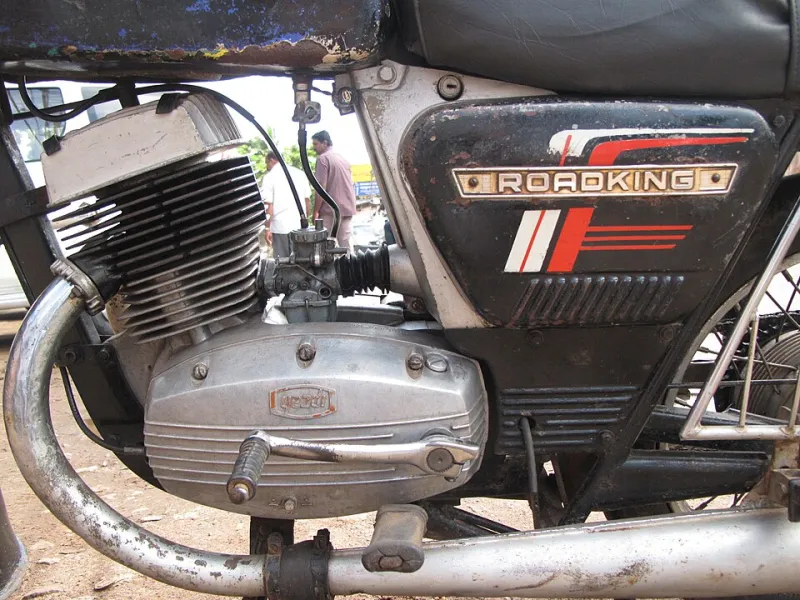
Photo: Etan Doronne, CC BY-SA 3.0, via Wikimedia Commons
There is a particular kind of quiet in a garage when someone says the word “squish”. It usually follows a conversation about a Bantam that nips up at the top of third, or a Villiers that has started pinking like a kettle full of spanners. Squish clearance is one of those jobs that sounds exotic until you actually do it. Then it becomes a bench exercise in solder, calipers and patience — with a bit of soot and marking blue thrown in for light relief.
On an air-cooled British lightweight, the squish band is the area where the piston crown and the cylinder head come close as the piston approaches top dead centre. The mixture gets squeezed out of that gap and into the combustion chamber, creating turbulence and helping the burn along. Get it right and the engine feels cleaner and more willing. Get it too tight and you are asking an old cast piston, a worn little-end and a 1960s conrod to behave like a modern race engine. They will not.
What the band is actually doing
A two-stroke does not have valves, a camshaft or a nice lazy four-stroke stroke to sort out its mixture. It relies on crankcase pressure, transfer ports and a tuned exhaust to fill and scavenge the cylinder. The squish band adds a little local turbulence near the top of the bore, which helps homogenise the charge and speeds up combustion. It also keeps the end gases away from the hottest part of the chamber, which is why a sensible squish can reduce detonation risk rather than increase it.
But “sensible” is the word. On a vintage air-cooled engine with a iron barrel, a pressed-up crank and pistons that have probably seen several decades of damp sheds, chasing a tight modern squish figure is a fool’s errand. You are not building a 2026 kart motor. You are trying to keep a 1950s lightweight happy on modern petrol.
Solder wire: crude, cheap and remarkably good
The classic method uses soft solder wire. You want a diameter slightly larger than the clearance you expect — for a typical British lightweight, 2 mm solder is a good starting point. Clean the piston crown, make sure the ring gaps are not lined up with the transfer ports, and lay two short pieces of solder across the crown at roughly 90 degrees to each other. Keep them outboard of the plug hole and away from the bore edge where they might catch a port.
Refit the head with the gasket you intend to use, torque it in the correct sequence, and turn the engine slowly through top dead centre by hand. Do not use the starter. Do not kick it over with enthusiasm. You are crushing solder, not testing the ignition. Then remove the head and measure the flattened ends with a digital caliper. Take several readings and use the average, not the thinnest smear you can find.
The crushed solder tells you the actual running clearance at the band. It also tells you whether the band is even. If one side is 1.2 mm and the other is 1.7 mm, you have a geometry problem, not a tuning opportunity.
Blue, soot and the contact pattern
Solder gives you the number. Marking blue gives you the shape. A thin smear of engineers’ blue on the piston crown — or on the corresponding face of the head — will transfer where the two surfaces come closest. After a slow turn through TDC, you can see the width and consistency of the squish band. A sooty crown from a rich-running engine can do a similar job, but it is messier and less repeatable. Engineers’ blue is cleaner and easier to photograph before you wipe it off.
What you are looking for is a band that follows the chamber shape evenly. On many small British two-strokes the band is not huge, and that is fine. A narrow, uneven smear on one side suggests the head is sitting cocked, the barrel deck is not square, or there is old gasket crud under one edge. A band that is wide on one side and absent on the other is worth investigating before you start removing metal.
Safe numbers for a British lightweight
There is no single figure that covers every Villiers, Bantam, Francis-Barnett and Greeves. The manual is always the first stop, and if the maker gives a clearance, use it. As a broad garage guide, many air-cooled British lightweights of the 1950s and 1960s will run happily somewhere around 1.2 to 1.6 mm of squish clearance. Some will be a little tighter from the factory; some will be looser. A worn engine with a tired crank and a piston that has been rebored twice is not the place to experiment with 0.9 mm.
Too tight and you risk contact when the piston expands, the rod stretches or the crank flexes at revs. Too loose and you lose some of the turbulence and burn quality, though the engine will usually still run. On a road bike, err on the safe side. A clearance of 1.4 mm that runs cleanly, does not pink and shows no contact marks is worth more than a fashionable 1.1 mm that makes the owner nervous every time they open the throttle.
When the pattern is uneven
Do not reach for the lathe first. Check the simple things. Is the head flat? Is the barrel deck clean and true? Is the gasket the same thickness as the one you measured with? Has the head been machined before and lost its original shape? Is the piston crown genuinely concentric, or has it been skimmed by a previous owner with more enthusiasm than measuring equipment? A straight edge and a feeler gauge will tell you more about a warped head than any amount of internet advice.
Also remember that squish is measured on a cold engine. Air-cooled components grow when they get hot, and a vintage iron barrel can move about more than you might expect. That is another reason not to chase the tightest possible figure. The engine you measure on a frosty November bench is not the engine that is working hard on a summer A-road.
The case for leaving well alone
If your lightweight starts easily, pulls cleanly, does not pink under load and shows no signs of piston-to-head contact, the squish number is probably fine. Skimming the head or fitting a thinner gasket raises compression, which means rethinking ignition timing and jetting. On an old two-stroke with a modest charging system and a carburettor that has seen better days, that is a rabbit hole with a oily bottom.
Measure it, record it, photograph the pattern and put the solder away. The millimetre that matters is the one that keeps the engine reliable, not the one that looks good in a forum signature. A vintage British two-stroke is at its best when it is slightly over-engineered and slightly under-stressed. Squish is no different.