The Last Oversize: Reboring a British Single When the Parts Book Runs Dry
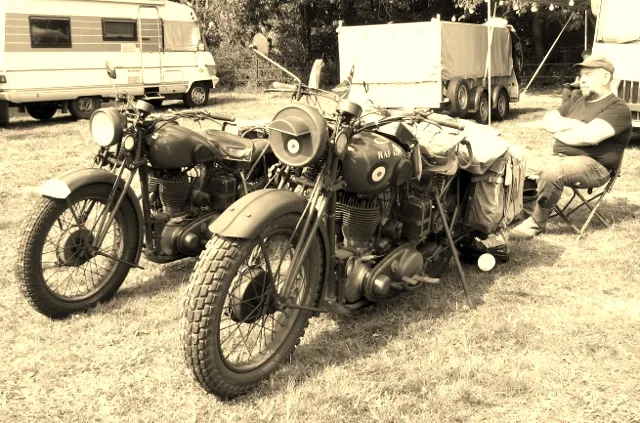
Photo: Evelyn Simak , CC BY-SA 2.0, via Wikimedia Commons
There is a particular silence in a garage when the barrel comes off, the bore gauge goes in, and the parts book says the last useful oversize is no longer available. For owners of British singles, that silence has become familiar. In 2026, the supply of new-old-stock pistons is thinner than it was, pattern pistons vary in quality, and the temptation to simply hone and hope is strong. Ten thousandths of an inch sounds tiny until it is the difference between a piston that rattles and one that nips. The answer is not to panic-buy the first shiny piston on an auction site. It is to measure, decide, and then spend once.
Start with numbers, not nostalgia
Before you ring a machine shop, establish what you actually have. A bore gauge reading at the top, middle and bottom of the barrel, taken on two axes at 90 degrees, will tell you about taper and ovality. A micrometer across the piston skirt, at the correct height and at right angles to the gudgeon pin, will tell you what piston you are really holding. Then check ring end gaps in the worn bore. Do not trust the eye, and do not trust a previous owner's claim that it was rebored shortly before the machine was laid up. That was possibly in 1987.
A British single barrel often wears into a barrel-shaped or oval bore rather than a clean cylinder. If taper or ovality is more than a few thousandths of an inch, honing is a cosmetic exercise. A hone can restore surface finish and help new rings bed, but it cannot put metal back or straighten a worn bore. If the bore is straight and only lightly glazed, and a suitable piston is available, a careful hone may be enough. If the bore has a pronounced lip at the top or a wear step, it is time to think about cutting metal.
The oversize ladder
The traditional ladder for many British singles runs +0.010, +0.020 and +0.040 in. In metric terms that is roughly 0.25 mm, 0.50 mm and 1.00 mm. Each step removes half that amount from the wall radius, so a +0.010 piston takes the bore out by 0.005 in on each side. It sounds modest, and it is, but every cut leaves less meat in the barrel and fewer future options. That is why the first question is not 'what is the biggest piston I can fit?' but 'what is the smallest oversize that will clean this bore?'
Availability drives the decision as much as wear. A +0.020 piston may be common while a +0.040 is extinct. A pattern piston may be listed as standard but measure oddly, or be heavier than the original, or use rings that are difficult to replace. If you are buying an oversize piston, have it in hand before the boring bar goes anywhere near the barrel. A good machine shop will want the piston anyway, so it can bore and hone to the actual skirt diameter rather than a catalogue number.
When a liner earns its keep
When the last oversize has gone, a thin-wall liner can be the difference between a matching-numbers barrel and a replacement casting. The old bore is opened out to take a pressed liner, the liner is fitted, and then it is bored and honed to the piston. Done properly, this restores a standard bore and keeps the original exterior, fins and engine numbers. Done badly, it can leave a barrel that is weak, distorted or impossible to rebore again.
A liner is not automatically the cheap option. The machining is skilled, the liner must be thick enough to be stable but thin enough not to break through, and the top flange and seating area need proper attention. Ask whether the shop has done this on air-cooled motorcycle barrels before. A liner that works in a stationary engine may not be happy in a finned barrel that heat-cycles on a Sunday run. If the barrel is cracked, porous or has damaged fins, a liner may be polishing a problem rather than solving it.
Picking a UK machine shop
Price per inch is not the only measure of a boring shop. Ask what equipment is used, whether the bore will be measured before and after, and whether the shop wants the piston in hand for final honing. Ask what clearance it intends to work to and why. A shop that knows a BSA B40 from a Ford Prefect is worth the extra drive. A shop that treats a vintage barrel like a modern alloy block may still do good work, but you want to hear the right questions being asked before you hand over the iron.
It also helps to discuss the ring type. Cast-iron rings, chrome rings and modern replacements may want different surface finishes. A finish that is too rough can wear rings quickly; one that is too fine can prevent bedding. If the shop can give you a written bore size and clearance figure, so much the better. That piece of paper is useful when the engine is back together and you are trying to work out why it is noisy, tight or smoky.
Clearance for the riding you do
Piston clearance is not a universal number. It depends on the piston material, the barrel's cooling, the intended load and the fuel. A cast piston in an air-cooled British single may want something in the region of 0.004 to 0.006 in, while a forged piston often asks for more. Treat any figure as a starting point and confirm it with the piston supplier. Too tight and you risk a nip-up on a hot day or a long climb. Too loose and you get piston slap when cold, noise when hot, and a short life for the skirt.
Be honest about the riding. A gentle Sunday rider and a sidecar tug are not asking the same thing of the engine. If the bike will be used for long tours, sustained A-road speeds or summer traffic, a little more clearance and a careful running-in period are sensible. Check ring end gaps in the finished bore as well. A typical cast-iron ring may want roughly 0.003 to 0.004 in per inch of bore, but the ring maker's figure always wins. File gaps square and deburr the ends.
The decision, made cold
The sequence is simple even when the emotions are not. Measure the bore and piston. Decide whether a hone will clean it. Check what pistons are actually available. If the next sensible oversize exists, use it and have the barrel bored to the piston. If the last oversize has gone but the barrel is sound, price a liner against a replacement barrel. If the barrel is damaged, stop pretending and find a better one. The goal is not to preserve every original molecule. It is to build a single that starts, pulls and survives a British summer. Originality is worth having, but only when it is bolted to something that runs.